
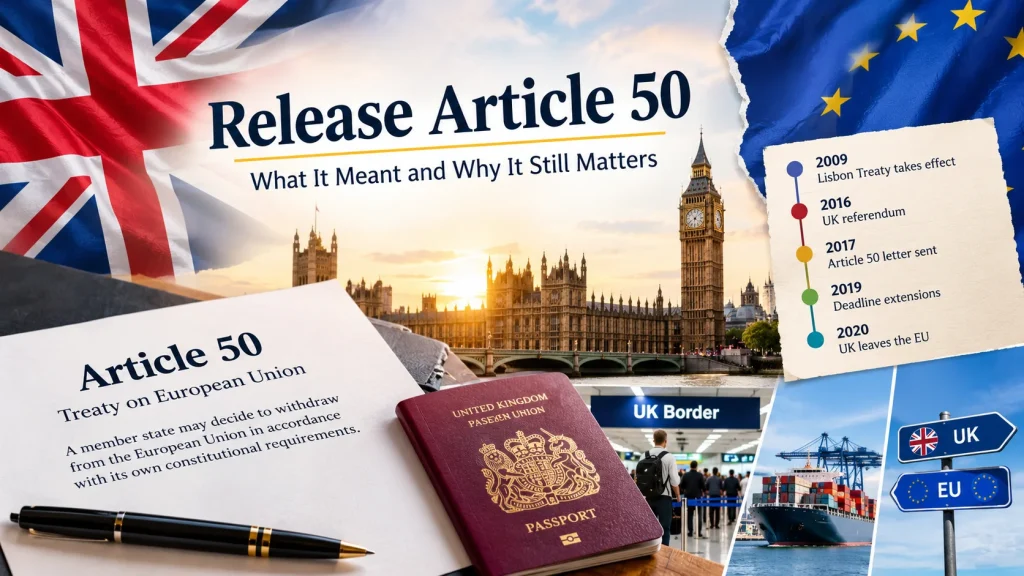
The release article 50: What It Meant and Why It Still Matters Few legal clauses made global headlines like Article 50 did. For years, people argued about it at work, at home, and online. The release article 50 story began when the UK chose to leave the European Union, and it changed daily life for millions of people. This guide explains it in plain words. You will learn what the clause says, how the process worked, and what happened next. Grab a cup of tea, and let's get started. ## What Is Article 50 in Plain English? Article 50 is a short rule inside the Treaty on European Union. It tells any member country how to leave the EU. Before this rule existed, no formal exit path was in place. ### Where the Rule Came From The Lisbon Treaty added Article 50. It took effect in December 2009. Most people had never heard of it until 2016. The authors wrote it as a safety valve. They wanted any member to have a clear, lawful way out. Nobody expected a big member like the UK to use it so soon. ### How the Exit Clock Works The rule is simple. A country decides to leave under its own legal rules. Then it tells the European Council in writing. That letter starts a two-year countdown. During that time, both sides negotiate the terms of the split. The clock can stop earlier if a deal is signed, or it can grow longer if every member agrees. ## The Road to the Release: A Step-by-Step Story The release article 50 moment did not happen overnight. Several big events came first. Each one shaped what followed. ### The 2016 Referendum On 23 June 2016, UK voters went to the polls. About 51.9 percent chose to leave the EU. The result shocked many people on both sides. Then a big question popped up. Who gets to start the exit process: the government or Parliament? That question landed in court. ### The Court Battle Over Who Decides Businesswoman Gina Miller led a legal challenge. Her team argued that only Parliament could trigger the exit. The government argued that it could act alone using its royal powers. The High Court sided with Miller in November 2016. The Supreme Court agreed in January 2017, with eight of eleven judges backing that view. The release article 50 plan now needed a vote in Parliament. ### The Letter That Started the Clock Parliament passed a short law in March 2017. Soon after, Prime Minister Theresa May signed a six-page letter. On 29 March 2017, the UK's ambassador handed it to European Council President Donald Tusk in Brussels. The countdown began that day. The two-year deadline pointed to 29 March 2019. Tusk said the UK had "delivered" after nine months of waiting. ## The Key Dates at a Glance A timeline helps here, because the story has many moving parts. This table shows the main steps from vote to exit. Read it top to bottom. | **Date** | **Event** | **Why It Mattered** | | --------------------- | -------------------------- | -------------------------------------------------- | | December 2009 | Lisbon Treaty takes effect | Article 50 became part of EU law | | 23 June 2016 | UK referendum | Voters chose to leave | | November 2016 | High Court ruling | Parliament, not the government alone, must approve | | January 2017 | Supreme Court ruling | The top court confirmed the High Court decision | | 29 March 2017 | May sends the letter | The two-year clock started | | March to October 2019 | Deadline extensions | Both sides needed more time | | 31 January 2020 | UK leaves the EU | The transition period began | | 31 December 2020 | Transition period ends | New trade rules started | ## Why the Two-Year Clock Did Not End the Story Most people expected a clean break in March 2019. That did not happen. The talks proved harder than anyone guessed. ### The Extensions The release article 50 timeline stretched because Parliament rejected the first withdrawal deal several times. Leaders in Brussels then agreed to extend the deadline. They did it more than once. The date moved from March 2019 to April, then to October, and finally to January 2020. Each extension needed approval from all EU members. That shows how the rule works in real life: the clock bends only when everyone agrees. ### The Deal and the Exit Boris Johnson's government reached a new withdrawal agreement in October 2019. Parliament passed it in early 2020. The UK left the EU at 11 pm GMT on 31 January 2020. A transition period followed. During those eleven months, most rules stayed the same. Then the two sides signed a trade agreement on Christmas Eve 2020, just days before the deadline. ## How It Changed Everyday Life Big legal news can feel far away. Yet this one reached kitchens, airports, and workplaces. Here are a few real examples. ### Travel and Borders British travelers now use different lanes at many EU airports. Passports need enough validity left on them. Visits to EU countries can last only 90 days in any 180-day period without a visa. ### Trade and Shopping Companies that sell goods across the Channel now fill out more paperwork. Small online shops felt this first. Some of them paused EU sales until they learned the new rules. Shoppers noticed it too. A parcel from a European seller sometimes arrives with extra fees. Checking the customs rules before you order saves a headache. ### Work and Study EU citizens who wanted to work in the UK need to follow the new immigration system. British citizens face similar steps in EU countries. Students also lost easy access to the Erasmus exchange program, although the UK later set up its own scheme. ## Common Myths About Article 50 Plenty of confusion floats around online. Let's clear up a few points. Short answers help most. **Myth: Article 50 means the UK left the day it started.** It did not. The letter only began the talks. The exit came almost three years later. **Myth: Only the UK can ever use it.** Any EU member can invoke the rule. Greenland left the EU's predecessor earlier by a different route, but Article 50 is the formal tool today. **Myth: Nobody can cancel after sending the letter.** In December 2018, the EU's top court ruled that a country can withdraw its notice on its own. That ruling came from a case brought by Scottish politicians. It gave the UK an option that it did not use. ## Lessons Anyone Can Take From This Story Even if you never plan to leave a union, this story teaches useful things. First, big decisions need clear steps. A vague plan leads to long fights. Second, deadlines can move, but only with agreement. Third, details matter. A single legal question about who holds the power took months to settle and shaped the whole path. Finally, change touches normal life. Passport lines, shipping fees, and school exchanges all felt the effect. Knowing the basics helps you read the news with more confidence. ## Frequently Asked Questions ### What does Article 50 do? It gives any EU country a legal way to leave the union. The country sends a written notice, and a two-year talking period begins. ### When did the UK trigger Article 50? The UK triggered it on 29 March 2017. Theresa May's letter reached Donald Tusk in Brussels that day. ### Why did the UK need Parliament's approval? The Supreme Court ruled in January 2017 that the government could not act alone. Parliament had to pass a law first. ### Did the two-year deadline change? Yes. EU leaders agreed to extend it several times. The final exit date became 31 January 2020. ### Can a country cancel the process after it starts? Yes. The EU's top court ruled in 2018 that a country can withdraw its notice on its own. The rule applies as long as the process has not finished. ## Final Thoughts The release article 50 story shows how a few lines of law can reshape a nation. The clause set out a two-year path, but real life took far longer. Courts, Parliament, and leaders in Brussels all played a part. Remember the key points. The Lisbon Treaty created the rule. The UK triggered it on 29 March 2017 after a court ruling. The country left in January 2020, and new trade terms began at the end of that year. If you follow one lesson, make it this one. Clear rules help, but patience helps more. Now you can explain this topic to a friend over coffee. content ar upor vitti kore amake akta image banai dao image size 16:9.
Life Style

The release article 50: What It Meant and Why It Still Matters

Few legal clauses made global headlines like Article 50 did. For years, people argued about it at work, at home, […]